
Introduction:
In the production of essential oils, it is important to choose the correct carrier oils. The content of fatty acids, texture, colour, odour, oxidation and chemical structure are different for each oil. So the best carrier oils are not necessarily those that are more expensive and commonly used. Before buying in bulk quantities, the buyer should pay attention to the botanical species, extraction, purity, stability and homogeneity.
Nowadays, naturally derived oils are very popular because of the worldwide demand for natural cosmetic ingredients. Scientific studies on cosmetics identify distinct fatty acid profiles in different oils, including jojoba oil, sweet almond oil, grapeseed oil, and coconut oil. Thus, for example, grapeseed oil consists of 67-71 percent linoleic acid and sweet almond oil consists of 57-64 percent oleic acid. This is significant information in choosing raw materials for formulations.
We supply various carrier oils for Aromaaz International. We offer a wide range of products to meet the needs of formulators, wholesalers, and industrial buyers who require consistent specifications and reliable bulk supplies.
What are the Best Carrier Oils for Essential Oils?
Formulators should choose a carrier oil based on its composition, physical properties, and specific formulation requirements. Rather than relying on any general descriptions of the product, buyers should compare the oils with their technical requirements.
Here are the most popular options for looking for the best carrier oils for diluting essential oils:
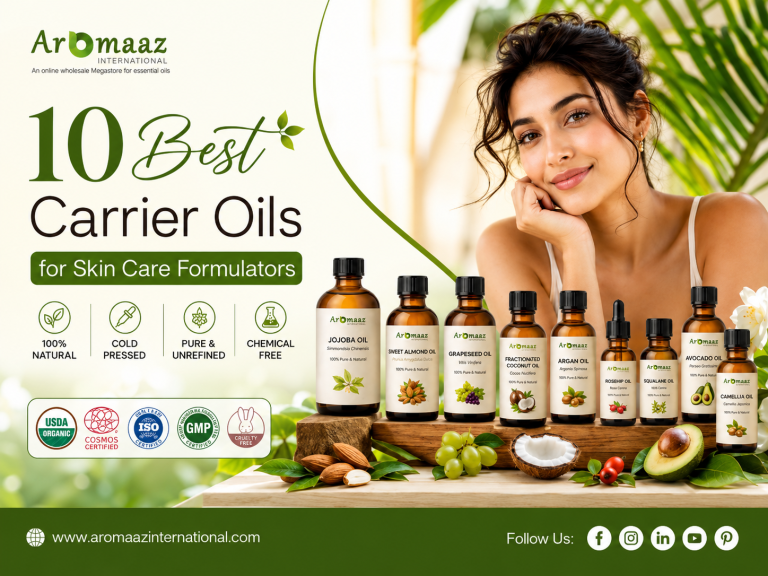
Jojoba Oil
Jojoba oil is actually a liquid wax ester and not a typical triglyceride vegetable oil. It is a different type of oil than most seed oils. It is relatively stable towards oxidation and has a relatively stable chemical composition.
Sweet Almond Oil
Sweet almond oil is a very popular edible oil derived from almonds. It has a high content of oleic acid followed by linoleic acid.
Fractionated Coconut Oil
Fractionated coconut oil is the process of separating out specific fatty acid fractions from coconut oil. This type of material tends to be liquid at room temperature. It has a different composition than ordinary virgin or refined coconut oil.
Grapeseed Oil
Grape seeds are used to make grapeseed oil. It is rich in linoleic acid and has a fairly light colour. It is especially important to be able to test it for oxidation due to its unsaturated fatty acid content.
Avocado Oil
The pulp of avocado fruit is used to make avocado oil. It consists mainly of oleic acid and also contains some other fatty acids. Extraction and refining methods can affect the colour and viscosity.
Apricot Kernel Oil
Apricot kernel oil is extracted from apricot fruit kernels. It is a blend of oleic and linoleic acids. Its physical properties are related to the raw material and processing conditions.
Choosing Best Carrier Oils for Commercial Formulations:
When choosing the base for your cosmetics, manufacturers and industrial buyers must go beyond just the product name to choose the right carrier oils for skin and other skin formulation bases. The raw material should conform to the formulation specifications and manufacturing needs.
Take these technical factors into account when procuring:
Botanical Identity
Check the scientific name of the plant. The names of products may be used for more than one plant. The supplier is responsible for giving the proper INCI name and botanical identification.
Extraction Method
The composition and physical properties of the final oil are influenced by extraction. Typical processing methods are:
- Cold pressing
- Expeller pressing
- Solvent extraction
- Refining
- Fractionation
The selected process should correspond to the grade of the product desired.
Fatty Acid Composition
Fatty acid analysis offers useful information for chemical identification of an oil. It also assists buyers in comparing batches and picking out the odd batches.
Oxidation Stability
The vegetable oils have fatty acids which can undergo reactions with oxygen. Oils with higher unsaturated fatty acid levels may need more frequent monitoring of oxidation. You can evaluate them using peroxide value measurements and other appropriate tests.
Colour and Odour
Colour and odour should be within the product specification agreed. Unusual variations could be processing differences, degradation or contamination.
Technical Quality Standards for Wholesale Carrier Oils
One of the key aspects of bulk ingredients procurement is quality verification. Before approving a carrier oil supplier, the buyers should ask for a technical specification sheet. Describe each oil based on its expected physical, chemical, and analytical properties.
Typically, the following parameters are tested:
Quality parameter
What it indicates
Acid value
Free fatty acid content
Peroxide value
Primary oxidation products
Iodine value
Degree of unsaturation
Saponification value
The average molecular parameters of fatty acids
Specific gravity
Specific gravity in relation to water
Refractive index
Doppler radar data (WMO data).Optical property/composition reference.
Fatty acid profile
The distribution of individual fatty acids
Colour and odour
Organoleptic characteristics
Moisture and impurities
Water and foreign material are present.
| Quality parameter | What it indicates |
|---|---|
| Acid value | Free fatty acid content |
| Peroxide value | Primary oxidation products |
| Iodine value | Degree of unsaturation |
| Saponification value | Average molecular characteristics of fatty acids |
| Specific gravity | Density relative to water |
| Refractive index | Optical property and composition reference |
| Fatty acid profile | Distribution of individual fatty acids |
| Colour and odour | Organoleptic characteristics |
| Moisture and impurities | Presence of water and foreign matter |
Buyers should determine a set of limits that they are willing to accept in the purchase specification for each parameter. The limits may vary depending on the type of oil, processing grade, and product category.
The results from a Certificate of Analysis (COA) should be provided for the actual batch, as opposed to the specified batch. A Technical Data Sheet (TDS) should include a description of the product’s regular characteristics. All such documents should be for the same botanical and commercial grade.
Cold-Pressed, Refined and Organic Carrier Oils
Another thing to take into consideration when comparing pure carrier oils for cosmetic formulations is the processing method. There are physical and chemical differences between the different grades.
Cold-Pressed Carrier Oils
Cold pressing uses mechanical methods to extract oil from seeds, kernels, and other plant materials without applying high temperatures. This process helps preserve the oil’s natural colour, aroma, and original properties while minimizing the need for additives.
Refined Carrier Oils
Refining: Treating crude oil to obtain desired commercial properties. It may remove some impurities, reduce the odour and colour and FFA, depending on the refining process.
Organic Carrier Oils
Organic certification is connected with the requirements for agricultural production and handling of raw material. It is important for the buyers of organic carrier oils in bulk to check the certification, product scope, validity and traceability before buying in bulk organic carrier oil.
ISO 16128 offers recommendations for the definition of natural and organic cosmetic ingredients. However, manufacturers should not use an ISO 16128 natural-origin calculation as a substitute for organic certification.
What Should Buyers Look For When Purchasing Wholesale Carrier Oils?
It is important to have a clear procurement process for choosing reliable carrier oil suppliers. Low quotes do not imply good product or supply quality.
There are a number of points that industrial buyers, formulators and distributors should consider when evaluating suppliers:
- Chemical purity: Check the botanical name, INCI name and source material.
- Batch consistency: Make comparisons between different COAs of different production batches.
- Processing information: Ensure that the oil is cold-pressed, refined or fractionated.
- Purity: Test for undeclared additives, foreign oils and unwanted residues.
- Lab testing/analytical procedures: Inquire about lab testing and analysis procedures.
- Traceability: Ask if raw materials are sourced from and what batch numbers are used.
- Packaging: Ensure appropriate packaging for storage and shipment internationally.
- Supply capacity: Production volume, availability, and lead times of stocks.
A dependable carrier oils manufacturer would be able to clearly specify the product and inform of any changes in raw materials supply or processing.
Bulk Carrier Oils Packaging, Storage and International Supplies
Depending on the amount of production and storage space, commercial buyers may need different packaging formats. Our bulk carrier oils range can be discussed for product availability, order quantity, and packaging requirements.
Common packaging materials used in industrial packing are:
- HDPE drums
- Food-grade or appropriate industrial containers
- Metal drums with matching internal coating.
- Intermediate bulk containers (IBCs)
- Smaller containers for evaluation and sampling
The choice of packaging should take into account the following: oil compatibility, protection from moisture, light and transport conditions. Seals on containers and batch labels should not be broken during transportation.
Conditions of storage also play a role. Most vegetable oils should be stored in tightly closed containers, out of direct sunlight, excessive heat and moisture. For oxidation-sensitive oils, if applicable, nitrogen flushing or appropriate management of head space can be considered.
In the case of international shipments, buyers are required to confirm:
- Net and gross weight.
- Package size and package capacity.
- Details of manufacturing and batch number.
- Country of origin.
- Export and shipping papers.
- Estimated delivery/teach times.
These checks can assist importers in forecasting stock levels and ensuring production continuity.
Why Aromaaz International – Carrier Oils in Bulk?
At Aromaaz International, we serve businesses that require a consistent supply of high-quality raw materials at competitive wholesale prices. Additionally, we offer a wide range of vegetable oils that manufacturers can use in essential oil blends and as key ingredients in cosmetic formulations. Moreover, we understand that industrial buyers need more than just a product catalogue. Therefore, we focus on delivering reliable bulk supplies, consistent product quality, and dependable B2B support to meet their specific business requirements.
They require precise specifications, communication and consistency of product quality in repeat orders.
These sourcing and supply of our carrier oils for wholesale can be discussed around:
- Various carrier oil types and quality.
- Bulk order/wholesale order requirements.
- Availability of product specifications and COA.
- Technical materials for evaluation by the buyer.
- Taking samples prior to commercial orders.
- Private labelling/packaging enquiries.
- Foreign Shipping & Export needs.
- Repetitive purchasing and ongoing supply contracts.
Our team will be happy to hear from businesses seeking carrier oils in bulk or by specific botanical variety/grade, quantity and destination. According to the purchase specification, appropriate product options can be discussed.
Conclusion:
Whether you are an importer, wholesaler, or manufacturer, our team supports your bulk procurement needs. Moreover, we ensure reliable assistance. Talk to a member of the sales team from Aromaaz International about your needs.
To get a quotation on wholesale carrier oils, please reach out to us.
Indicate the product name, botanical specification, grade, quantity required, preferred packaging and destination country. Our team will go through the details and discuss a quotation.
Searching for a reliable bulk carrier oils supplier? Check our carrier oil range at Aromaaz International and get wholesale pricing, technical specifications, samples and enquiries about the supply of carrier oils worldwide.
Get in touch with Aromaaz International today.
Phone: +91 9643342464
Email: sales@aromaazinternational.com
Frequently Asked Questions
Q-1: Do you offer bulk purchases of carrier oils from Aromaaz International?
Yes. Specialist in supplying for industrial and wholesale needs. Customers can provide their favourite oil type, grade, quantity and delivery address for a supply quote.
Q-2: Are there any carrier oils with which you do private labelling?
You can discuss private labelling options and customised packaging requirements based on the selected product, order quantity, packaging specifications, and commercial arrangements.
Q-3: Do you have carrier oils available for overseas shipping?
We process enquiries for sourcing worldwide. International buyers may provide the buyer’s country where the products will be shipped, and the quantity of the products they need to have exported and shipped.
Q-4: Do you have COA and technical documentation?
Product documentation can be requested upon procurement. Documents available can be COA, TDS, SDS and other quality or product-specific documents.
Q-5: May Customers ask for samples prior to bulk orders?
Before commercial procurement, you can discuss sample requirements with our sales team. They will also confirm product availability, sample quantities, shipping arrangements, and applicable charges based on your selected product.
Q-6: Do you have an option to make regular oil deliveries?
Yes. For regular purchases, you can discuss monthly or quarterly quantities, delivery schedules, and procurement arrangements with our sales team. This helps ensure a smooth and consistent supply.
Q-7: Where can I find a quote for carrier oils for wholesale?
Provide product name, botanical specification, grade, quantity needed, preferred packaging and destination country. Our team can discuss the details and provide a quote.
Author Bio:

Gaurav Gupta is the author of this post. He is the Director of Aromaaz International, an entrepreneur, writer, and essential oils expert with over 15 years of experience in essential oils manufacturing, and supplying around the globe. Passionate about natural wellness, he shares practical insights on essential oils, aromatherapy, and botanical ingredients, helping readers and businesses make informed, quality-focused decisions.