

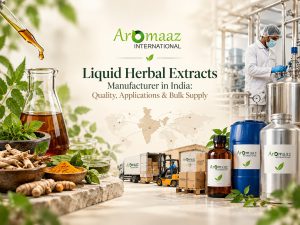
India has become one of the world’s busiest corners of the botanical trade. First of all, it is worth saying that India cultivates, harvests and processes more than 8,000 plant species having proven value for the medicine and beauty industries, and the market for liquid herbal extracts is growing at about 8–11% annually, which is quite high by today’s standards for the ingredients market. This growth is caused by a definite shift in consumers’ behaviour. People are turning to natural products that can be named and traced.
India is right in the middle of abundant raw materials, well-established cultivation and harvesting practices; and deep knowledge about how to process the plants. Formulators in Europe, North America and Southeast Asia keep circling back to Indian suppliers because the raw material is close to the soil, the processing knowledge runs generations deep, and the pricing holds up at volume. The supply chain remains vertically integrated from farm gate to finished drum.
If you buy liquid herbal extracts in bulk for cosmetics, nutraceuticals or personal care, the source you choose determines your consistency, your paperwork and your margins. Aromaaz International manufactures and exports liquid herbal extracts from India. Our products are standardised, documentation-ready, and built for buyers who order by the drum rather than the bottle. Let us understand more about liquid herbal extracts: how they are obtained, their benefits, liquid herbal extracts wholesale supply and more.
What Are Liquid Herbal Extracts?
Liquid herbal extracts refer to plant parts such as leaves, roots, barks, seeds, and flower parts, among others, processed into a fluid form to provide easy access to the active components. Liquid herbal extracts are highly concentrated products made from the extraction of bioactive compounds such as flavonoids, alkaloids, terpenes and glycosides. The extraction process of these products requires the use of solvents such as water, ethanol, glycerine and glycol combinations. As a result of the extraction process, one ends up with pourable concentrates that can be easily measured and formulated without dusting problems associated with powdered products.
They are much more bioavailable and quickly absorbed than the dried powder form and encapsulated form. In contrast to the solid forms, liquid forms are easier to blend, dose and formulate into the final formulation. Liquid forms have great importance in cosmetics and personal care because of solubility and skin feel issues.
This also makes them a preferred ingredient choice for formulations of nutraceuticals, food & beverages, and Ayurvedic medicines. Manufacturers who source liquid herbal extracts online from us get full batch documentation, COA, MSDS, and standardised phytochemical profiles with every order.
- Extraction ratio tells you how much raw herb went in.
- Solvent base decides carrier compatibility and microbial behaviour.
- Active marker (% or mg/g) confirms the material is standardised, not just coloured.
How Are Liquid Herbal Extracts Made
How are liquid herbal extracts made on an industrial scale? The process is straightforward in principle and unforgiving in practice.
- Sourcing and identity testing — raw herb is verified by botanical name.
- Pre-treatment — cleaning, drying and size reduction to a defined mesh.
- Extraction — maceration, percolation, or modern ultrasonic and counter-current methods, depending on how heat-sensitive the actives are. Aloe, neem, liquorice root and green tea each demand a different hand.
- Concentration and filtration — the liquor is concentrated under controlled temperature and clarified.
- Standardisation — the batch is adjusted to a target marker so batch 1 and batch 50 behave the same in your formula.
- Preservation and packing — food-grade or cosmetic-grade preservative systems, then HDPE drums, jerry cans or IBC totes.
Liquid Herbal Extracts for Cosmetics – A Popular Product Line
Our fastest-selling product line consists of liquid herbal extracts for cosmetics. Major cosmetic brands are switching their formulations from artificial actives to natural active ingredients, and our liquid herbal extracts have taken on this important role.
Some of the most popular extracts used in cosmetic products include:
- Neem Extract – antibacterial, acne treatment
- Turmeric Extract – anti-inflammatory, skin lightening
- Aloe Vera Extract – soothing, hydration
- Ashwagandha Extract – adaptogen, anti-ageing
- Green Tea Extract – antioxidant, protection
- Liquorice Root Extract – depigmentation, skin toning
- Amla Extract – high vitamin C, nourishing for skin and hair
- Centella Asiatica Extract – wound healing, collagen formation
- Manjistha Extract – detoxification, complexion boosting
- Rose Extract – anti-ageing, hydrating, aromatherapy
- Our experts adjust the ratio of glycerin to water, the ethanol content, and the standardisation according to your formulation requirements. Private labelling available.
Applications Across Industries:
The liquid extraction of plants for use in cosmetics is still prevalent among our queries. Queries concerning aloe vera, neem, hibiscus, amla, brahmi, shikakai, and green tea form the majority of the queries. The plants are used in the production of serum, shampoo, hair tonic, face wash, body lotion, and male grooming products.
Beyond cosmetics, the benefits of liquid herbal extracts move into:
- Nutraceuticals and dietary supplements — tinctures, drops and ready-to-drink formats
- Ayurvedic and traditional medicine — classical formulations and modern adaptations
- Personal care and home care — soaps, hand washes, oral care, pet care
- Food and beverage — herbal flavour and functional infusion blends
One formulation note worth keeping in mind: glycol and glycerin bases blend cleanly into water-based systems, while alcohol-based extracts need a compatibility check before you scale. Get that wrong, and you discover separation at the worst possible moment — in the filling line.
Bulk Supply and Private Labelling
Bulk liquid herbal extracts from India come in packs scaled to your production, from 1 kg HDPE bottles through 25 kg drums to 200 kg and IBC totes. We work with private label and white label buyers who need the extract under their own brand, their own pack, and their own artwork. That covers custom extraction ratios, custom solvent systems, custom active levels and retail-ready filling when required.
Minimum order quantities are flexible. If you’re new to a specific extract, request a sample first. We would rather send a sample for a bench trial than have you commit to a drum you can’t use.
Liquid herbal extracts: online enquiries often start with a spec sheet request, and that’s the right way to begin. Send us your target marker, solvent preference and expected monthly volume, and we’ll come back with a quotation and a realistic timeline.
Conclusion :
India’s advantage isn’t only price. It’s vertical integration — cultivation, collection, processing and export under one regulatory umbrella. Buyers in the EU watch REACH and cosmetic regulation compliance; US buyers watch FDA facility registration and GRAS status where relevant. We keep documentation current for these markets and can supply organic-certified lots, kosher and halal declarations, and GMP-compliant manufacturing records where the project calls for them. Aromaaz International is a leading global exporter and liquid herbal extract manufacturer in India.
As a liquid herbal extract supplier to formulators on four continents, the measure we care about is whether the next order is easier than the last one.
Partner with Aromaaz International for liquid herbal extracts that meet the quality standards your markets demand. We are backed by a consistent supply, full documentation, and a global logistics network ready to move when you are. Request your specification sheet or sample today.
For bulk orders and inquiries, please contact us at the details below:
Phone: +91 9643-342-464
Email: sales@aromaazinternational.com
Frequently Asked Questions
Q-1: – What is the minimum order for bulk liquid herbal extracts?
It depends on the botanical and the extraction ratio. Common extracts such as aloe vera or neem start lower, while rare or seasonal herbs need larger commitments. Share your specifications and monthly volume for an exact figure.
Q-2: – Can you supply liquid herbal extracts for private labelling?
Yes. We offer private label and white label supply, including custom extraction ratios, custom solvent bases and retail-ready packaging under your own brand. Send your artwork and pack requirements with the enquiry.
Q-3: – Can we get a sample before placing a bulk order?
Yes. Samples of most catalogue extracts are available on request. Sample kits are typically dispatched within 3–5 business days and include a full COA and technical data sheet for your evaluation.
Q-4: – How do you ensure consistency across bulk batches?
Each batch is standardised to defined active compound ratios and tested through GCMS, heavy metal screening, and microbial analysis. Batch-to-batch consistency reports are available on request for ongoing supply agreements.
Q-5: – What documentation comes with each consignment?
Every batch ships with a Certificate of Analysis, MSDS, specification sheet, and origin and allergen statements. Organic, Kosher and Halal certificates are available on request where applicable.
Q-6: – Do you offer custom extraction or new product development?
Yes. If the extract you need is not in our standard catalogue, our R&D team can develop a custom extraction specification within 4–6 weeks. We work with your target actives, solvent preferences, and standardisation requirements.
Author Bio:

Gaurav Gupta is the author of this post. He is the Director of Aromaaz International, an entrepreneur, writer, and essential oils expert with over 15 years of experience in essential oils manufacturing, and supplying around the globe. Passionate about natural wellness, he shares practical insights on essential oils, aromatherapy, and botanical ingredients, helping readers and businesses make informed, quality-focused decisions.